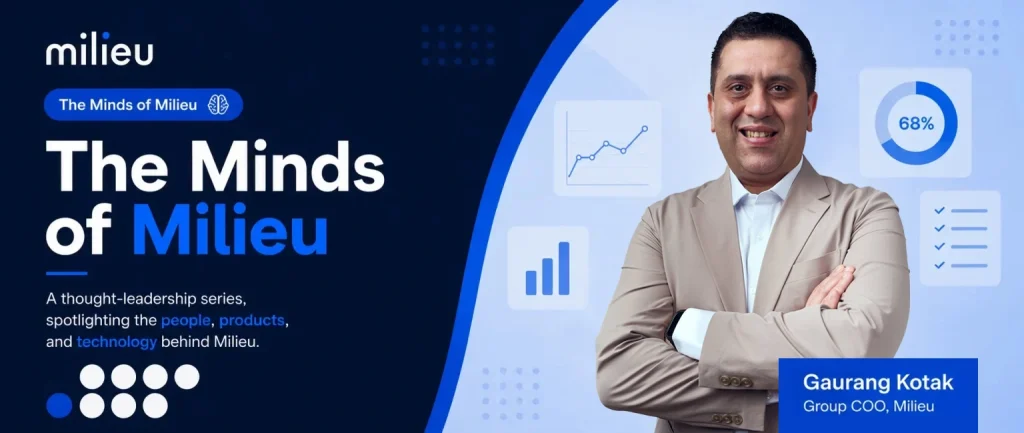
A conversation with Gaurang Kotak, Group COO of Milieu, on the blind spots in campaign measurement—and why marketers can no longer afford to wait weeks for answers.

Every marketer knows the feeling: the campaign is live, the budget is committed, and the results won’t be clear for another six weeks. By the time the report lands, the moment to act has usually passed.
It’s a frustration Gaurang Kotak (GK), Group COO of decision intelligence company Milieu, has heard time and again. As campaigns become more fragmented across channels and audiences, marketers are under growing pressure to make faster, smarter decisions without sacrificing confidence.
We sat down with GK to talk about what’s still missing from campaign measurement, why speed has become just as important as accuracy, and what marketers should be thinking about as they plan for 2027.
The gap dashboards don’t close
Marketing has never had more data, yet making sense of campaign performance remains surprisingly difficult.
Part of the challenge, GK explains, is structural. A campaign often passes through multiple teams. From brand and creative to media and activation, each measures success differently. While many organisations have become more sophisticated in how they execute campaigns, understanding what truly drove impact is still far from straightforward.
“Many marketers still struggle to clearly understand how their campaigns have performed or whether they’ve genuinely created brand lift,” he says.
From conversations with clients, GK sees four recurring challenges.

The first is cost. Robust campaign measurement is often seen as something reserved for large budgets, leaving many brands to launch important campaigns without meaningful evaluation.
The second is timing. Today’s campaigns unfold simultaneously across digital, social, retail, and traditional channels. Waiting weeks, or even months, for answers means opportunities to optimise have already passed.
“Waiting for pre- or post-campaign results for weeks isn’t really an option anymore,” he says.
Then comes fragmentation. Campaign measurement is still too often treated as a series of standalone studies. Useful individually, perhaps, but disconnected from the bigger picture. Marketers increasingly need consistent benchmarks that allow them to compare performance over time, not simply assess campaigns in isolation.
Finally, there’s context. Knowing whether a campaign performed well is only part of the story. Understanding why it performed that way and what changed between the idea, its execution, and its outcome enables better decisions next time.
Building around the marketer, not the process
These conversations shaped Milieu’s approach to campaign intelligence.
Rather than asking marketers to fit into lengthy research cycles, GK believed measurement needed to fit around the pace of modern marketing.
That meant making campaign evaluation easier to launch, quicker to access, and flexible enough to work for different campaign sizes and budgets. It also meant giving marketers the ability to build a continuous view of campaign performance over time, rather than starting from scratch with every project.
“The opportunity wasn’t just to make campaign measurement faster,” GK explains. “It was to make it practical enough that brands could build it into the way they already work.”
For him, better measurement isn’t about producing more reports. It’s about helping teams make better decisions while campaigns and budgets are still in motion.
Looking beyond individual studies

GK believes marketers are beginning to rethink research in much the same way they’ve rethought customer data.
Rather than treating every project as a separate exercise, more organisations are looking to connect insights across campaigns, categories, and time. Viewed together, those individual studies become something much more valuable: an evolving body of knowledge that helps teams recognise patterns, learn faster, and make more confident decisions.
Technology plays an important role in making that possible, but GK is careful not to see it as the destination.
“Technology should reduce the effort it takes to get to an insight,” he says. “The real value still comes from asking the right questions and knowing how to act on the answers.”
Looking ahead to 2027

As marketers prepare for another year of uncertainty, GK believes the biggest opportunity isn’t necessarily spending more; it’s learning faster.
Industry studies continue to show that many campaigns fail to deliver the returns brands expect, while surprisingly few organisations consistently measure campaign effectiveness in a meaningful way. For GK, those numbers highlight an opportunity rather than a problem.
“We invest enormous amounts into building brands and creating great campaigns,” he reflects. “Sometimes even a small insight into what’s working, or what isn’t, can make a meaningful difference.”
His advice for marketers heading into 2027 is simple: don’t think of campaign measurement as something that happens after the campaign ends. Think of it as part of the campaign itself.
Because the brands that succeed won’t simply be the ones with the biggest budgets. They’ll be the ones that learn, adapt, and make better decisions while everyone else is still waiting for the report.


