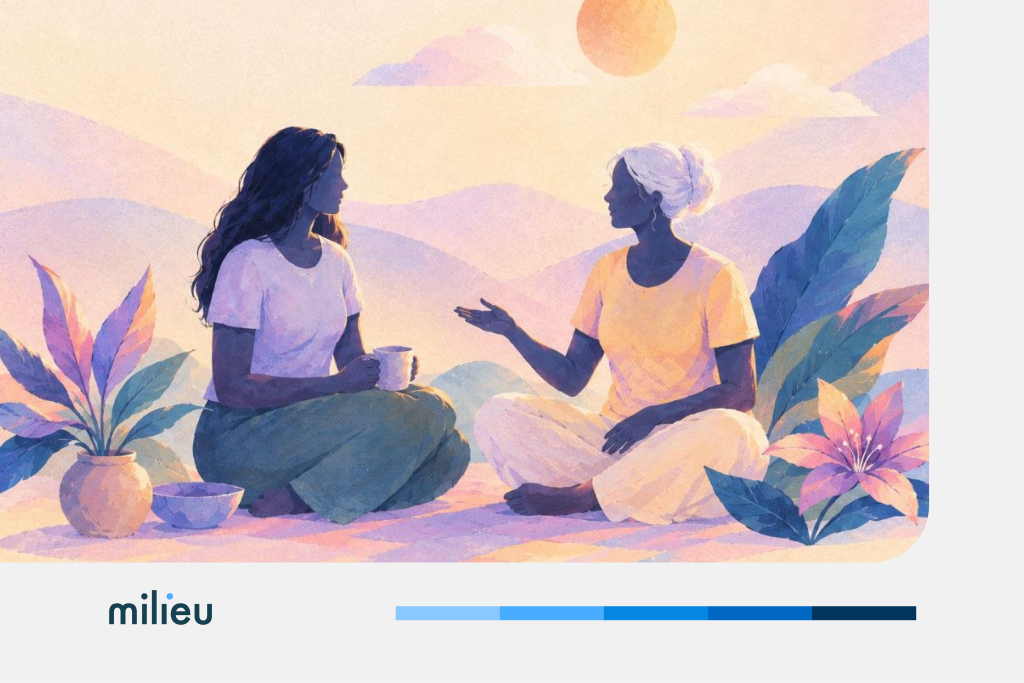
Most of us learned about periods from someone. A mother at the kitchen table, a teacher at school, a friend who knew a little more than we did. Menopause is different. For many women in Southeast Asia, it is something that is rarely discussed at home, even when older generations have been through it themselves.
Our survey of 3,000 women across Singapore, Malaysia, Thailand, Indonesia, Vietnam and the Philippines shows just how much of that conversation is still missing.
Nearly half have never talked about it
46% of women say they have never spoken with their mother, aunt or grandmother about menopause. Fewer than one in ten have talked to an older female relative about their own experience.
The more common conversation, reported by 27%, is about the older relative’s menopause rather than the younger woman’s own questions or concerns.
There are also clear differences across the region. Singapore has the highest share of women who have never had this conversation, at 61%, followed by Malaysia at 47%, Thailand and Indonesia at 45%, and Vietnam at 42%. The Philippines is the most open, although 39% of women there still say they have never discussed menopause with an older female relative.
Interestingly, age does not change the picture very much. Across every age group, from 18–24 to 45 and above, between 44% and 49% say they have never spoken with an older female relative about menopause.
Learning about menopause without talking about it
Family is still the most common source of first information about menopause, cited by 29% of women. But with so many families not discussing it directly, that learning can be quite informal.
16% say they never really learned about menopause at all and simply picked things up along the way.
The Philippines stands out. Almost half of Filipino women (48%) say family was their first source of information. In Singapore and Malaysia, meanwhile, 24% and 22% respectively say they never really learned about menopause, compared with just 4% in the Philippines.
The numbers suggest that where family conversations are happening, they can play an important role in how women first understand menopause.
Support does not always follow the conversation
Talking about menopause is one thing. Having support through it is another.
44% of women say their partners, family or close friends are not very involved or not involved at all in supporting them through this stage. In Singapore, that rises to 58%.
Vietnam and the Philippines report the highest levels of active support, with close to one in five women saying their loved ones are very involved and proactive.
Younger women are learning somewhere else
For younger women, school appears to be filling part of the gap.
30% of women aged 18–24 say they first learned about menopause at school, compared with 11% of women aged 45 and above. Older women are also more likely to say they never really learned about it, with 22% saying so.
This points to a shift in where women get information about menopause. What was once mostly something learned, or not learned, within the family may increasingly be introduced through formal education.
A conversation that could change with the next generation
There are signs that the silence may not last forever.
43% of women believe younger generations in Southeast Asia are more likely to talk openly about menopause than their mothers’ or grandmothers’ generation.
That belief is strongest in Vietnam, where around six in ten women agree. In Malaysia, it is lowest at 31%.
The data suggests that the conversation is already beginning to move. It may not happen in one big, defining moment. It may simply start with a question, a shared experience or a conversation that previous generations never had.
A regional survey of 3,000 women across Singapore, Malaysia, Thailand, Indonesia, Vietnam, and the Philippines (500 per market, fielded 9 to 16 October 2026) examined how women feel about menopause, how openly it is discussed, and how they seek support. The results point to a region where menopause is seldom seen as taboo but is still rarely talked about, and where many women hold off on seeking care. Interested to access the full dataset? Get in touch with us at sales@mili.eu